

Published · 17 June 2025
Painting tips: how to give your home a fresh new look
Painting is about far more than choosing a brush and a tin of paint: a whole range of tools and preparation is needed if the result is to be durable and good-looking. Proper planning and sourcing the right materials are key to a successful painting project.
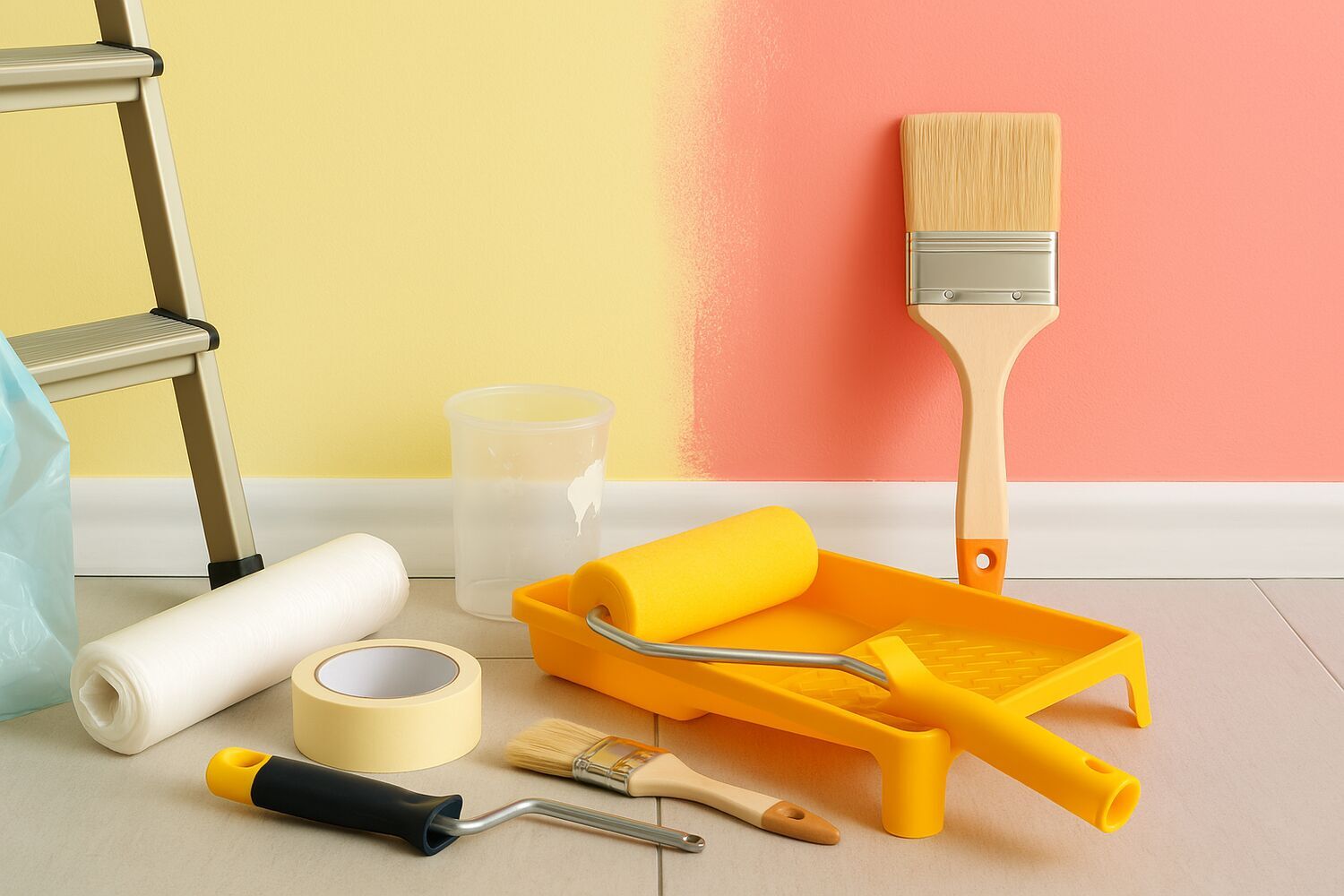
1. The basic kit: what you should not be without
Buying a brush and some paint is not enough. You will also need the following:
- Masking tape — for marking out edges and borders precisely.
- Dust sheets — to protect furniture and floors.
- Paint roller — for covering large wall surfaces evenly.
- Brush — for painting corners and edges accurately.
- Sandpaper — for preparing the wall and removing defects.
- Filler and a spatula — for smoothing walls and repairing unevenness.
- Thinner — for adjusting the consistency of the paint.
- Roller tray — for applying paint evenly.
- Ladder and telescopic pole — for reaching higher areas.
- Cleaning equipment — for removing excess paint and tidying up.
2. Preparing the wall: why the base matters
Before you start painting, make sure the wall is properly prepared. Begin by removing old paint and dirt. Sand the wall surfaces down lightly to obtain a smooth, even base. Fill any cracks and holes, then wait for the filler to dry completely. Always paint onto a clean, dust-free surface — dust and loose layers ruin the paint’s adhesion.
3. Technique: don’t rush it
A common mistake is to apply too much paint at once, which makes it run and flake off the wall. The best result comes from building up thin layers. Apply the paint gradually, in several coats. Always work from top to bottom, starting from the corners. Use a brush for the edges and a roller for the larger surfaces. Take your time and let each coat dry before applying the next.
4. The role of colour: how it shapes the sense of space
Colours do not only create a mood; they also shape a room optically.
- Coloured ceiling and floor: the room appears lower but wider.
- Coloured back wall and floor: a stronger spatial effect that widens the room sideways.
- Coloured ceiling and back wall: the space feels wider but shorter.
- Coloured side walls: the room appears narrower, extending towards ceiling and floor.
- Coloured back wall only: a restrained, elegant backdrop that sets off the furniture.
- Every wall coloured except ceiling and floor: the space feels enclosed, open upwards and downwards.
- All walls and the floor coloured: the room feels tight and closed in, almost oppressive.
- One side wall and the back wall coloured: the light surfaces make the space feel taller, while the coloured walls make it read as more enclosed.
5. Finishing: the details count
Once you have finished painting, remove the masking tape and dust sheets and clean your tools thoroughly. Wait for the paint to dry completely before putting the furniture back. Colour choice and technique have to work together if the result is to be not just striking but long-lasting. A well-planned and well-executed paint job lifts the mood of a home and improves the sense of space at the same time.
Knowledge base
More articles
How can this home become yours?
Get in touch and our colleague will answer every question — from financing to the technical specification.